A wiki for people and AI
At Soft Kultura, our team and our AI agents share a wiki. It brings together our internal documentation and a record of every team meeting. When someone asks an everyday work question, their agent can draw on how we work and what we’ve agreed. It sees only the files that person can access.
(2026)
for my own company, Soft Kultura
several months from idea to company-wide use
The problem
By 2026, everyone on our team used AI agents, but our documentation was scattered across Notion, Google Sheets, GitHub and team chats. Some of it was out of date, and for some questions only a few people knew the answer.
Our agents relied on search across those tools and often missed things we’d already written down. Most meetings had no transcript or summary. When someone explained how something worked or the team agreed to change it, that knowledge often stayed with the people on the call. We needed a routine way to capture it in our documentation while keeping sensitive discussions private.
What I built
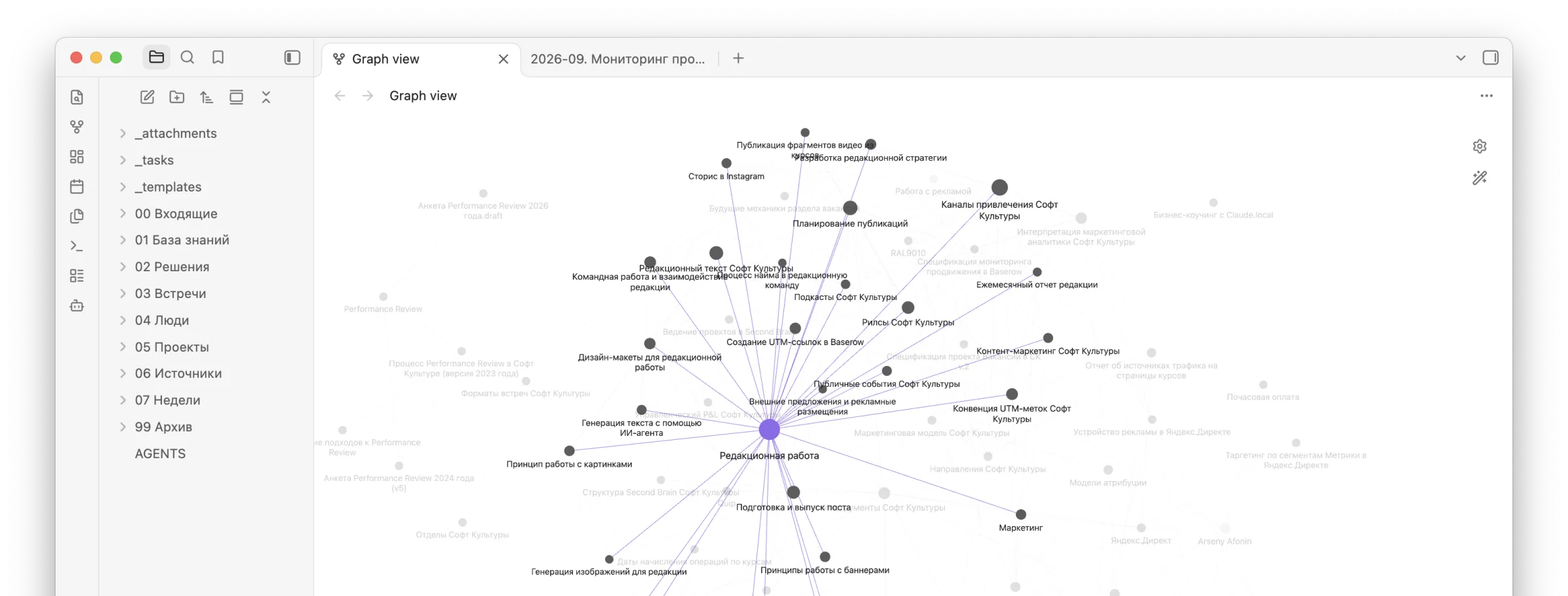
I designed the wiki in Obsidian as a network of linked notes. Internal guides, meeting records and project documents link to one another wherever their subjects overlap. People and agents can start with the note they find and follow its links to the context they need.
I also wrote instructions for agents to review meeting records and identify what belongs in our documentation. An agent can pick up an explanation that nobody has written down before, or spot a decision that changes an existing rule. It finds the relevant notes and proposes edits for someone on the team to approve.
I also set up access for individual files. Each employee opens an ordinary Obsidian folder containing the notes they can read. Links between those notes work as usual, even when other documents in the same wiki are confidential.
The result
- We spend less time explaining our company to our agents. They can answer routine questions and draft documents using the rules, decisions and working practices that apply to our team.
- Agents help keep the wiki current after meetings. They turn what the team discussed into proposed changes, so the person reviewing a note already has a draft to work from.
- Every department now uses the wiki, and people write project specs more often. Running it on our own server and employees’ computers also costs less than the cloud service did.
How it works
Each note is a plain Markdown file. People edit the files in Obsidian. I chose local files because Codex and Claude Code can read and update related notes much faster when they can work through a whole folder without waiting for a cloud service to open or save each note. Folders separate reference notes from meeting records, project files and source material. Links connect related documents across those folders, and the repository keeps a history of every change.
For version control and sync, I chose Subversion, an alternative to Git that lets us set access permissions for individual files in one repository. Each note specifies who can read it. The server checks those permissions when it syncs the wiki, so only the files an employee can access reach their computer.